

The Complete Guide to Hiring a Branding Agency in Canada
In a digital landscape saturated with noise, standing out is no longer just a design challenge—it’s a business survival imperative. You might have the best product in your industry or the most efficient service delivery in your province, but if your target audience doesn't instantly recognize, trust, and connect with who you are, you are leaving significant revenue on the table. This is where the specialized expertise of a branding agency becomes your most valuable asset.
Many business owners mistakenly equate "branding" with a logo or a colour palette. While these visual elements are the tip of the iceberg, the massive structure beneath the surface—your strategy, voice, positioning, and emotional resonance—is what actually drives customer loyalty and premium pricing. A professional branding agency does not just make things look pretty; they engineer the perception of your company in the minds of your customers.
For Canadian businesses operating in a diverse and competitive market—from the tech hubs of Toronto and Vancouver to the industrial sectors of Alberta and the retail landscapes of Montreal—finding the right partner to articulate your unique value is critical. You are likely reading this because you sense a disconnect between how good your business is and how it is perceived by the market. Perhaps you are scaling up and your DIY branding from five years ago no longer fits, or maybe you are launching a new venture and need to hit the ground running.
This guide is designed to cut through the jargon and provide you with a transparent, actionable roadmap. We will explore exactly what a branding agency does, how they differ from marketing firms, what you should expect to pay in the Canadian market, and how to vet potential partners to ensure a return on your investment. By the end of this article, you will have the knowledge to navigate the agency landscape with confidence and secure a partnership that transforms your business identity.
Key Takeaways
- Branding is Strategy, Not Just Design: A true branding agency focuses on why you exist and who you serve before they ever draw a logo.
- Long-Term Asset Value: Consistent branding can increase revenue by up to 23%, making it a capital investment rather than an expense.
- Distinct from Marketing: While marketing agencies push your message out to drive immediate sales, branding agencies pull customers in by building long-term trust and identity.
- Canadian Cost Reality: Expect to invest between $5,000 and $20,000+ for comprehensive branding from a reputable boutique agency in Canada.
- Vetting is Crucial: Always ask about ownership rights, strategic process, and specific industry experience before signing a contract.
What Actually Is a Branding Agency?
A branding agency is a specialized firm dedicated to creating, planning, and managing your company's branding strategies. Unlike a generalist design studio that might simply execute a brief to "make a logo," a branding agency acts as a strategic consultancy. Their primary role is to uncover the DNA of your business and translate it into a cohesive system that communicates your value to the world without you having to say a word.
At its core, a branding agency solves the problem of obscurity and commoditization. When you look at your competitors, you might see businesses that offer similar services at similar prices. A branding agency helps you break out of that "sea of sameness" by defining a unique position in the market. They work to align your internal culture (who you are) with your external presentation (how you look) and your customer experience (how you feel).
The Three Pillars of Agency Work
Most top-tier branding agencies organize their work around three critical pillars:
- Brand Strategy: This is the foundational "thinking" phase. It involves market research, competitor analysis, and defining your brand's mission, vision, values, and archetype. It answers the question, "Why should anyone care about this brand?"
- Brand Identity: This is the "making" phase. Once the strategy is set, the creative team develops the visual and verbal systems. This includes the logo, typography, colour palettes, photography style, and tone of voice.
- Brand Experience/Activation: This is the "doing" phase. It involves applying the brand across various touchpoints—websites, packaging, office environments, and marketing collateral—to ensure consistency.
For a Canadian business owner, hiring a branding agency is an investment in your company's reputation. It is the difference between being seen as a "local vendor" and a "market leader." The agency provides the outside perspective that is often impossible to achieve internally, helping you see your business through the eyes of your most valuable customers.
Why Canadian Businesses Need Professional Branding Now
The Canadian market is currently undergoing a significant shift. With the rise of digital-first competitors and the globalization of services, local businesses can no longer rely solely on word-of-mouth or legacy reputation. Trust has become the new currency of commerce, and professional branding is the fastest way to build that trust at scale.
The Economics of Trust
According to global data from the Interbrand Best Global Brands reports, the world's most valuable companies share one common trait: a relentlessly consistent brand. For small to mid-sized businesses, the stakes are just as high. Statistics indicate that presenting a brand consistently across all platforms can increase revenue by up to 23%. When a customer sees a cohesive professional image—from your website to your invoice design—it signals reliability, stability, and quality. This psychological assurance allows you to charge a premium for your services, moving you out of the "race to the bottom" on price.
Talent Acquisition and Retention
Branding isn't just for customers; it's for your team. In Canada's tight labour market, top talent wants to work for companies with a clear purpose and a strong reputation. A branding agency helps articulate your "Employer Brand," making your company more attractive to high-quality applicants. If your external brand looks dated or confused, prospective employees often assume your internal operations are equally disorganized.
Navigating the "Trust Deficit"
Consumers are increasingly skeptical of generic, faceless corporations. There is a growing trend in Canada toward supporting local, authentic, and values-driven businesses. A branding agency helps you unearth and articulate your specific values—whether that's sustainability, community focus, or innovation. By wearing these values on your sleeve (visually and verbally), you attract customers who share those beliefs, creating a loyal tribe rather than just a transactional customer base.
Branding vs. Marketing Agencies: The Critical Differences
One of the most common sources of confusion for business owners is distinguishing between a branding agency and a marketing agency. While the two disciplines overlap and must work together, they serve fundamentally different functions and operate on different timelines. Understanding this distinction is vital to ensure you hire the right partner for your current needs.
Think of it this way: Branding is your personality; Marketing is your voice. Branding defines who you are, while marketing amplifies that definition to a specific audience.
Comparison: Branding vs. Marketing
| Feature | Branding Agency | Marketing Agency |
|---|---|---|
| Primary Focus | Identity, Strategy, Perception | Promotion, Lead Gen, Sales |
| Time Horizon | Long-term (5-10 years) | Short-term (Campaign cycles) |
| Key Deliverables | Logo, Guidelines, Brand Book, Strategy | Ads, SEO, Social Posts, Email Funnels |
| Goal | Build Loyalty & Trust (Pull) | Drive Action & Awareness (Push) |
| Emotional Driver | "This is who we are." | "Buy this now because…" |
| ROI Measurement | Brand Equity, Recognition, LTV | Click-throughs, Conversions, ROAS |
The "Pull" vs. "Push" Dynamic
Branding is often described as a "pull" strategy. A strong brand pulls customers toward you because they identify with your values and aesthetics. It creates a gravitational field where customers seek you out. Marketing is a "push" strategy. It pushes your message out to audiences to interrupt them and get their attention.
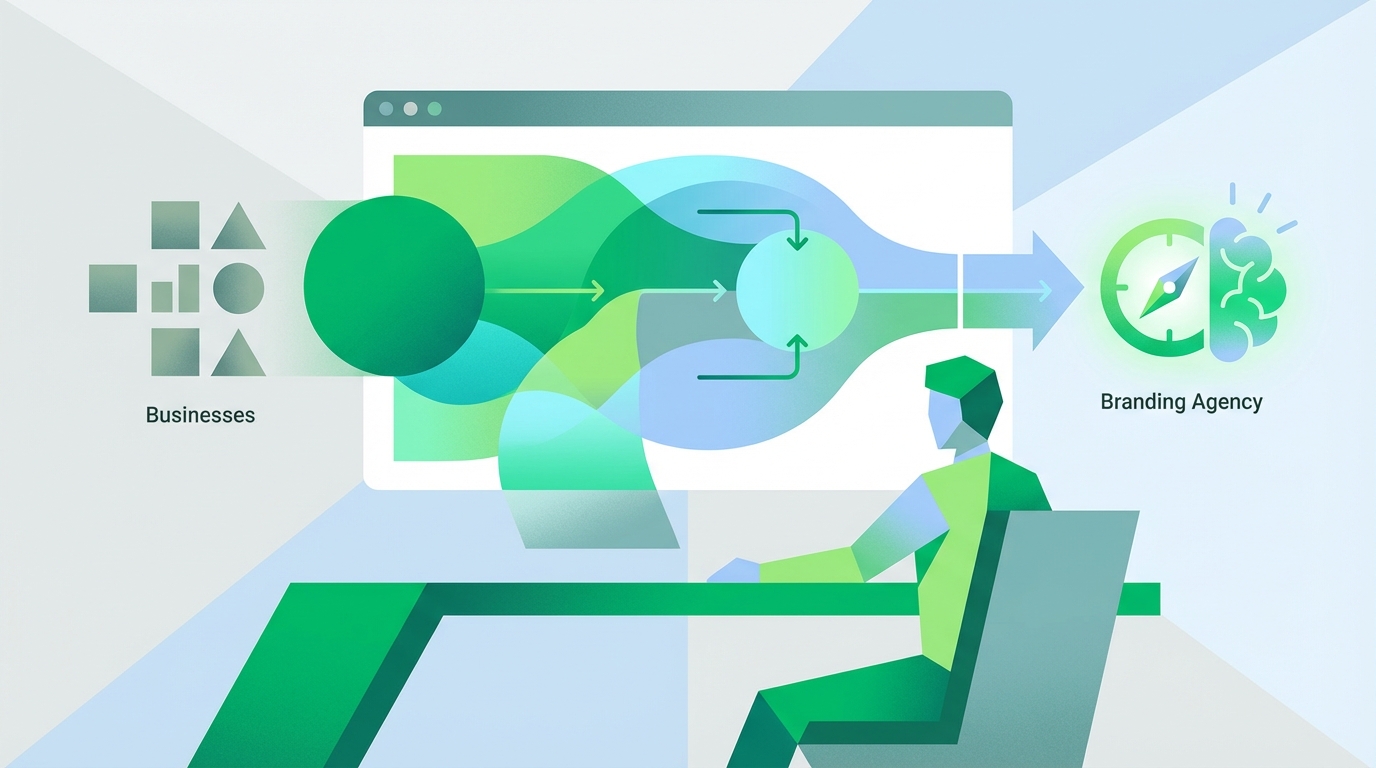
If you hire a marketing agency before you have a solid brand foundation, you risk spending money to amplify a weak or confusing message. You might get clicks, but if the destination (your brand experience) is lackluster, those clicks won't convert into loyal customers. Conversely, if you have a beautiful brand but no marketing, you have a "best-kept secret."
Ideally, you engage a branding agency first to build the foundation. Once that is solid, you can effectively use strategies for finding the perfect digital marketing agency to promote that new identity to the world.
The Core Services You Should Expect
When you engage a branding agency, you aren't just buying a logo. You are purchasing a comprehensive suite of services designed to build a robust business asset. While packages vary, a reputable Canadian branding agency will typically offer a scope of work that includes the following:
1. Research and Discovery
This is the "diagnosis" phase. Before prescribing a solution, the agency must understand the patient.
- Stakeholder Interviews: Talking to your leadership and staff to understand internal culture.
- Customer Research: Surveys or focus groups to understand current market perception.
- Competitor Audit: Analyzing your top 3-5 competitors to find gaps in the market you can exploit.
2. Brand Strategy
This is the blueprint for your business's future.
- Positioning Statement: A concise description of your target audience and how you uniquely help them.
- Brand Archetype: Defining the "character" of your brand (e.g., The Hero, The Sage, The Outlaw).
- Messaging Framework: Key pillars of communication, elevator pitches, and tagline development.
3. Visual Identity Design
This is where the strategy becomes visible.
- Logo Design: Primary logo, secondary marks, and icons.
- Colour Palette: Primary and secondary colours with specific usage rules (print vs. digital).
- Typography: Selection of font families for headers, body text, and accents.
- Graphic Elements: Patterns, textures, or illustration styles that support the brand.
4. Brand Guidelines (The "Bible")
Perhaps the most critical deliverable, the Brand Style Guide ensures consistency long after the agency leaves. It is a manual that tells your team and future vendors exactly how to use the brand assets. It covers everything from "minimum logo size" to "tone of voice in emails."
5. Implementation and Launch
Some agencies also assist with the rollout.
- Stationery: Business cards, letterheads, presentation decks.
- Digital Assets: Social media profile kits, email signatures.
- Website Design: Applying the new identity to your digital storefront.
The Process: How a Branding Agency Works With You
Entering a partnership with a branding agency is a collaborative journey. It is not a passive process where you pay money and wait for a reveal; your input is required at critical junctures. Understanding the typical workflow helps you prepare your team and manage expectations.
Phase 1: Immersion and Audit
The agency starts by "downloading" your brain. They will likely facilitate a workshop—either in-person or virtual—where you will dig deep into business goals. You should be prepared to share your business plan, revenue targets, and honest frustrations about your current market position. This phase often takes 2-4 weeks.
Phase 2: Strategic Definition
Based on the immersion, the agency will present a strategy document. This will not contain designs yet. Instead, it will propose the direction. For example, "We recommend positioning your financial firm not as a 'safe bank' but as an 'adventurous wealth partner'." You will need to approve this strategic direction before any design work begins. This prevents the "I don't like it" reaction later on, because the design will be based on an agreed-upon strategy.
Phase 3: Creative Exploration
The designers go to work. They will typically present 2-3 distinct "creative concepts" or "territories." Each concept will show how the brand could look and feel based on the strategy. You will see the logo applied to mockups (t-shirts, websites, trucks) to help you visualize it in the real world. You will select one direction to refine.
Phase 4: Refinement and Finalization
Once a direction is chosen, the agency refines the details. This involves tweaking colours, perfecting kerning (letter spacing), and expanding the system. This is where the Brand Guidelines are written.
Phase 5: Handover and Launch
The agency delivers the final files (vectors, PNGs, fonts) and the guidelines. They may also help you plan a "Launch Day" to unveil the new brand to your employees and the public. To ensure this new identity actually drives growth, you might look into how a digital marketing agency can transform your business by leveraging these new assets in active campaigns.
How to Evaluate and Select the Right Partner
Choosing a branding agency is like choosing a co-founder for a few months. You need chemistry, trust, and shared vision. In Canada, the options range from freelance collectives to massive multinational firms. Here is how to filter them.
Portfolio Relevance Over "Wow" Factor
When reviewing portfolios, don't just look for pretty pictures. Look for problem-solving. If an agency has only done edgy, grunge designs for breweries, they might not be the right fit for your corporate law firm. Ask them: "What was the business challenge here, and how did this design solve it?"
Assess Their Strategic Depth
During the sales process, pay attention to the questions they ask you. Are they asking about your favourite colours? That’s a red flag. A strategic agency will ask about your profit margins, your customer retention rates, and your 5-year business goals.
Cultural Fit
You will be spending a lot of time with these people. Do you like them? Is their communication style compatible with yours? If you are a fast-moving startup, a slow, bureaucratic agency might drive you crazy. If you are a conservative institution, a rebellious creative shop might be too risky.
The Pitch Process
Be wary of agencies that promise to "do a free logo" just to win your business. Professional branding requires research. Spec work (free work done on speculation) is generally a sign of inexperience or desperation. Instead, ask for case studies and references.
For a deeper dive into the specific inquiries you should make during the interview process, review our guide on 10 essential questions to ask before hiring a digital marketing agency. While the title says "digital marketing," the questions regarding process, reporting, and partnership are perfectly applicable to branding agencies as well.
Budgeting for Branding in Canada
One of the most difficult questions to answer is "How much does branding cost?" because the answer is always "It depends." However, to give you a realistic framework for the Canadian market in 2025/2026, here are the typical tiers.
Tier 1: The Freelancer / Solopreneur ($1,000 – $5,000)
- Who: An independent graphic designer working alone.
- Best for: Micro-businesses, side hustles, or testing a concept.
- Deliverables: Logo, basic colour palette, simple business card design.
- Pros: Affordable, direct communication.
- Cons: Limited strategic input, bandwidth issues, "single style" risk.
Tier 2: The Boutique Agency ($5,000 – $25,000)
- Who: A small team (3-10 people) with a strategist, creative director, and designers.
- Best for: Small to medium-sized businesses (SMBs) looking to scale, rebrand, or launch professionally.
- Deliverables: Full strategy, comprehensive identity system, brand guidelines, basic collateral.
- Pros: Strategic depth, diverse creative skills, professional project management.
- Cons: Higher cost than freelancers, may have a waitlist.
Tier 3: The Established/Large Agency ($30,000 – $150,000+)
- Who: Large firms with 50+ employees, often with offices in Toronto, Montreal, or NYC.
- Best for: Large enterprises, national chains, government bodies.
- Deliverables: extensive market research, focus groups, massive identity systems, global trademarking support.
- Pros: Can handle massive complexity, prestige.
- Cons: Very expensive, you might get passed to a "junior team" after the sales pitch.
ROI Note: Remember that branding is a capital expense (CAPEX) that depreciates over 5-10 years. A $15,000 investment amortized over 5 years is $3,000/year—a small price to pay for the foundation of all your marketing.
Red Flags When Hiring a Branding Agency
Not all agencies are created equal. As the barrier to entry in the design world lowers with software tools, many inexperienced providers present themselves as "agencies." Protect your business by watching out for these warning signs.
1. The "Yes" Men
If an agency agrees with everything you say, run. You are hiring them for their expertise, not to be a pair of hands. A good partner will push back on your bad ideas and explain why something won't work in the market.
2. Lack of Process
If they can't clearly explain the steps they will take to get from A to B, they are likely making it up as they go. Branding is a disciplined process, not a magical artistic fugue state.
3. Holding IP Hostage
Check the contract carefully. Some agencies try to retain ownership of the design files until you pay extra fees. You must ensure that upon final payment, you own 100% of the intellectual property, including the vector source files.
4. Cookie-Cutter Portfolios
If every logo in their portfolio looks the same (e.g., same trendy font, same minimalist icon style), they are not designing for the client; they are designing for their own ego or following a fleeting trend.
Trends Shaping Canadian Branding
The branding landscape is evolving. In 2025 and beyond, several key trends are influencing how Canadian companies present themselves.
Sustainability and Ethics
"Greenwashing" is out. Canadian consumers are savvy and demand proof of sustainability. Branding is shifting toward transparency—using honest materials, clear language, and highlighting supply chain ethics. Brands that authentically integrate sustainability into their story are winning loyalty.
Indigenous Reconciliation and Inclusion
There is a powerful and necessary movement in Canada toward acknowledging Indigenous roots and ensuring inclusivity. Brands are becoming more conscious of cultural appropriation and are actively seeking to be more inclusive in their imagery and language, reflecting the true diversity of the Canadian population.
Digital-First Branding
Historically, logos were designed for letterheads. Today, a logo must be legible as a tiny 16×16 pixel favicon on a browser tab or an app icon on a phone. Agencies are prioritizing "responsive logos" that can scale down to their simplest forms without losing meaning.
Nostalgia and Comfort
In uncertain economic times, consumers gravitate toward the familiar. We are seeing a resurgence of retro typography, warm colour palettes (earth tones over neon), and "human" imperfections in design to create a sense of comfort and stability.
Maximizing the Relationship for Long-Term Growth
Once you have selected an agency and the project is underway, your role shifts to "collaborator." The best results come from clients who are involved but respectful of the creative process.
Provide clear, consolidated feedback. Instead of sending ten emails with "make it bigger" or "change this blue," gather all stakeholder feedback into one document. Be specific about problems, not solutions. Say "This feels too aggressive for our older demographic," rather than "Use a rounder font."

Finally, remember that a brand launch is just the beginning. Your new brand is a living asset. As your business grows, you may need to revisit the strategy. You might eventually look into scaling your digital marketing agency (or your internal team) to handle the increased volume of leads your new brand generates. View your branding agency not as a one-off vendor, but as a long-term consultant you can call on for "brand health checks" annually.
FAQ
How long does a branding project take?
A typical comprehensive branding project for an SMB takes between 6 to 12 weeks. This allows time for research (2 weeks), strategy (2 weeks), design exploration (2-4 weeks), and refinement/guidelines (2-4 weeks). Rushing this process often leads to generic results.
Can I just get a logo without the strategy?
You can, but it is not recommended. A logo without strategy is just a decoration. It might look nice, but it has no "hook" to hang your business value on. Most reputable agencies will refuse to do "logo only" work because they know it won't solve your business problems.
What is a "Brand Book" or "Style Guide"?
This is a document (PDF or digital) that outlines the rules of your brand. It includes your mission, logo usage (do's and don'ts), colour codes (HEX, CMYK, RGB), typography, and examples of the brand in action. It is essential for keeping your brand consistent as you hire new employees or vendors.
Should I hire a local agency or can I work remote?
Remote work is now the standard. You can absolutely hire an agency in Toronto if you are based in Halifax. However, for retail or hospitality businesses where the physical space is key, having a local agency that can visit your site might offer a slight advantage.
How do I measure the ROI of branding?
ROI on branding is measured over the long term. Look for metrics like:
- Short term: Increased conversion rates on ads (because the creative is better).
- Medium term: Ability to raise prices without losing customers.
- Long term: Lower cost of customer acquisition (CAC) because your brand awareness does the heavy lifting.
Conclusion: The First Step to Market Leadership
Hiring a branding agency is one of the most significant inflection points in a company's lifecycle. It signals that you are moving from "surviving" to "thriving." It is a declaration that you believe in the value you provide and are willing to invest in communicating that value to the world.
In the Canadian market, where quality and trust are paramount, a professional brand is your badge of credibility. It aligns your team, attracts your ideal customers, and builds a moat around your business that competitors cannot easily cross.
Don't let your business remain the "best-kept secret" in your industry. If you are ready to find a partner who can translate your vision into a powerful brand identity, the next step is to explore your options.
Ready to find the perfect branding partner?
DMA Canada specializes in connecting Canadian businesses with top-tier agencies that match their specific needs, budget, and industry. Whether you need a boutique creative shop or a full-service strategic firm, we can help you navigate the search.